
Music distribution vs music publishing: what’s the difference?
Music publishing and music distribution are two separate but related parts of the music industry. The main difference between the two lies in what they do, and how they help you get paid as an artist or creator.
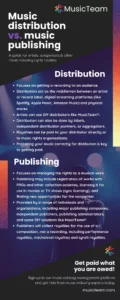
While publishing traditionally involves managing the rights and royalties associated with musical works (compositions), distribution is focused on getting recordings out there for your audience.
Here we’ll take a broad look at how publishing and distribution differ in the big picture. But, remember, the music industry is complex, and regulations and laws differ from country to country. In addition, distribution and publishing services continue to evolve with the changes to the music economy, and you may find some overlap in areas that were traditionally more distinct. If in doubt, contact your provider to make sure you understand what they can do for you.
Key takeaways
- A distributor handles getting a recording to listeners.
- A publisher handles the rights to a musical work itself.
- While their role is related to artists’ being paid for their work, the way in which they are involved in royalty collection varies according to a number of factors, including location, types of royalties, individual distributor or publisher contracts, etc.
Table of contents
What is music distribution?
Music distribution focuses on getting a recording to an audience. The person or company that does this is called a music distributor. They act as the middleman between an artist or record label, digital streaming platforms (like Spotify, Apple Music, Amazon Music) and physical stores, helping artists deliver their recorded music to the platforms where it will be heard. They may provide a full service, in which they manage your assets, or they may provide the means by which you can manage your own music assets through a music catalog.
 How are royalties collected during music distribution?
Royalties are a key component of music distribution. However, depends on where, and how, your music is distributed, royalties may be collected by different entities.
For example, digital music distribution services will help you get your recording to an audience on digital streaming platforms like Spotify and Apple Music. These platforms pay your distributor directly and then the distributor pays you according to the distribution agreement.
Music distribution services will help you by providing guidelines for how to prepare your recording in the correct format for distribution, support for splitting royalties among multiple band members, artists and performers, and access to detailed analytics so you can track your streaming numbers, downloads, and revenue data.
Distributors typically do not collect publishing royalties for the underlying composition since streaming platforms will pay these to music rights organizations. To collect those, a songwriter or publisher needs to register with a separate organization, such as a ASCAP or BMI and The MLC in the US, or SOCAN, SOCAN RR or CMRRA in Canada.
Who provides music distribution services?
When discussing music distribution in general, the organizations that provide this service can be broadly categorized into a few types:
Open or DIY (Do-It-Yourself) distributors
These are companies, like MusicTeam, that allow any artist to sign up and upload their music for distribution to digital platforms like Spotify, Apple Music, and others. They often operate on a subscription model, a per-release fee, or by taking a percentage of the artist’s royalties. This model has democratized the process, making it possible for independent artists to release music without a record label.
Major distributors
These are the distribution arms of the major record labels—Universal Music Group, Sony Music Entertainment, and Warner Music Group. They handle the distribution for their own signed artists and often for other independent labels and artists through their subsidiaries. They have direct deals with streaming platforms and significant leverage in the industry.
Independent distribution partners
These companies typically sit between the DIY distributors and the major distributors. They often work with a curated roster of artists and labels who have already shown some success. They provide more hands-on services than an open distributor, such as marketing, promotion, and playlist pitching, in exchange for a percentage of the royalties.
Aggregators
This term is often used interchangeably with “distributor,” but an aggregator is essentially a third-party service that acts as a bridge between a large number of artists or smaller distributors and the streaming services. They collect and process a huge volume of music and metadata to deliver to the various platforms.
There are pros and cons to each service, and if you are not satisfied with your current distributor, remember that it may be possible for you to change music distributors.
What is music publishing?
Music publishing focuses on managing the rights to a musical work (the underlying song, including the melody and lyrics). To be sure you understand this type of music asset, take a look at our article about the difference between musical works and sound recordings.
Publishing includes tasks like registering the song with performance rights organizations (PROs) and other collection societies, licensing the song for use in movies or TV shows (sync licensing), and finding new opportunities for the songwriter. It can also involve protecting the copyright of your musical work, depending on your location and contract.
How are royalties collected by music publishers?
A music publisher will collect royalties for the use of a composition, not a recording. The royalties associated with a musical work include:
Performance royalties: Collected when the song is performed publicly (e.g., played on the radio, in a restaurant, or live).
Mechanical royalties: Collected when a song is reproduced, either physically (e.g., a CD) or digitally (e.g., an on-demand stream).
Sync royalties: Collected when the song is licensed for use in a visual medium like a film, TV show, or commercial.
The songwriter vs. publisher relationship is complex, and defined by multiple intricate laws.
Who provides music publishing services?
Music publishing services are provided by a range of individuals and organizations, each with a different approach and level of involvement.
Here are the main types of entities that provide music publishing services:
Major publishing companies
These are the largest players in the industry, often affiliated with the major record labels (e.g., Sony Music Publishing, Universal Music Publishing Group, and Warner Chappell Music). They offer full-service deals that typically involve a significant advance to the songwriter in exchange for a share of the copyright and a large portion of the royalties. In addition to administration, they actively pitch songs to other artists, music supervisors for film and TV (sync licensing), and work to create career-building opportunities for their writers.
Independent publishers
These companies operate outside of the major label system. They can range from small, boutique firms to large, global companies. They often have a curated roster of writers and can offer a more personalized approach than the majors. Their deals can vary but often include a co-publishing agreement, where the songwriter and publisher share copyright ownership.
Publishing administrators
This is a more modern model of music publishing. A publishing administrator’s role is to handle the administrative tasks of publishing without taking any ownership of the songwriter’s copyright. They register the songs with various performance rights organizations (PROs) and other collection societies around the world, track down all the royalties, and then pay the songwriter their share after taking a smaller administrative fee (typically 10-25%). This is a popular choice for independent songwriters who want to maintain full ownership of their work.
DIY (Do-It-Yourself) solutions
Some distributors and music technology companies like MusicTeam® now offer music registration services or publishing administration as an add-on to their core distribution service. This allows artists to manage both their distribution and publishing from a single platform, often for a lower cost. This option provides the tools for administration but generally lacks the creative services and networking opportunities of a traditional publisher.
MusicTeam® is an all-in-one platform: distribution, registration, catalog management and more
Getting paid as a songwriter-producer-performer always involves having the support of key players in the music industry, including distributors and publishers.
At MusicTeam®, we provide distribution services to independent artists. On our all-in-one platform, you can access music catalog management, registration services, one-on-one help and more. Let us help you manage music distribution and metadata, so you can devote your time and energy to your music.
Join now to receive comprehensive support to get your music heard by a global audience.